
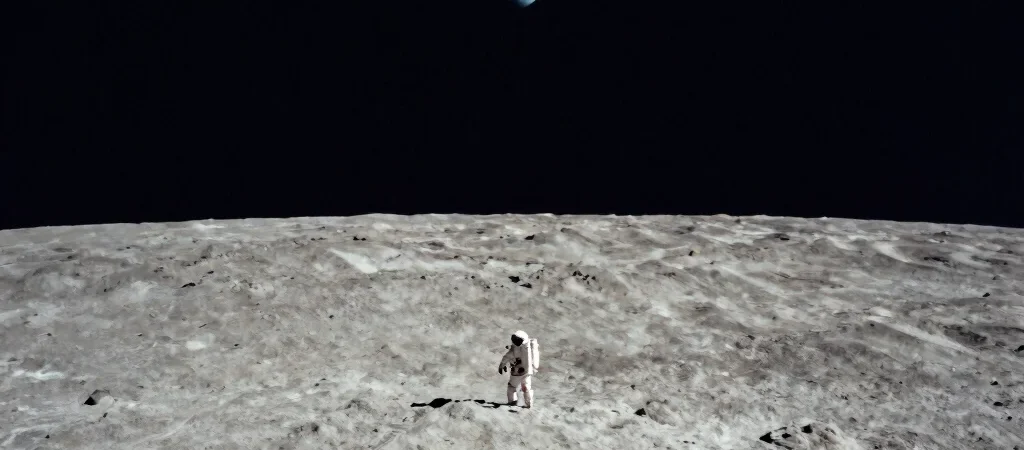
Stand on the Moon at noon and the ground can be bright with sunlight, while the sky overhead remains black. That contrast seems odd until you separate two things we often treat as one: light reaching a surface and light scattering through the space around it.
Light needs something to scatter
On Earth, sunlight meets molecules in the atmosphere and scatters in many directions. Some of that scattered light reaches your eyes from across the sky, making the daytime sky appear bright and blue.
Space has far fewer particles to scatter sunlight across the view. The light still travels through it, but unless it enters your eyes directly or bounces off an object, the path between the Sun and that object looks dark.
Bright ground, dark sky
The Moon has no thick atmosphere to spread sunlight around, so its sunlit surface can stand out against a black sky. The same basic contrast appears in space photographs: a spacecraft or planet may be brilliantly lit even as the background stays dark.
There is another wrinkle in photographs. Camera exposure is often set to show a bright surface clearly, which can make faint stars disappear from the image. The stars have not switched off; the camera is balancing very different levels of brightness.
Follow the light
A useful next stop is NASA's educational material on light and Earth's atmosphere, where scattering helps connect the blackness of space to the blue of our own sky. Keep the distinction in mind: darkness does not mean sunlight is absent; it can mean there is little nearby to scatter that light toward you.